

Inter-limb asymmetry has been one of the most frequently researched topics in recent years, with most studies showing that it is present across different sporting tasks and physical abilities (Bishop et al., 2018). In strength and conditioning, we are always interested in the asymmetry percentage and whether we can use it to help prevent injuries. Which test is relevant and gives us useful information? Over the next few blog posts, we will try to answer some of these questions.
Every player has some asymmetry in a particular ability or muscle group. Can any of these tests tell us what is actually happening on the pitch, and when should we really pay attention?
What Is Inter-Limb Asymmetry?
Inter-limb asymmetry refers to an imbalance in performance between opposite limbs. The relationship between unilateral and bilateral performance has encouraged research into whether a reduced capacity in one limb also shows up during bilateral exercises, potentially affecting sports performance (Fox et al., 2023).
Football players need to perform a combination of movements that require maximal lower-limb strength and explosive ability, such as jumps, sprints and changes of direction. Despite the range of physical abilities needed in football, strength is a key quality that underpins successful performance in these tasks (Bishop et al., 2021). Repeatedly performing these movements, which involve considerable musculoskeletal forces and joint loading, may lead to inter-limb asymmetry in functional performance, with the preferred leg potentially becoming dominant. Testing these physical abilities therefore provides an ecologically valid way of assessing football players, meaning that the tests reflect the demands players face in actual football situations (Bishop et al., 2022).
Does Inter-Limb Asymmetry Affect Football Performance?
Research so far has produced mixed results. In some studies, greater inter-limb asymmetry was associated with slower sprinting and poorer change-of-direction ability, while others found no such relationship. This is why we cannot simply say that “greater asymmetry means worse performance”.
A good example is a longitudinal study of elite U23 football players, who were tested during pre-season, mid-season and at the end of the competitive season. Asymmetries were assessed during unilateral countermovement jumps (CMJ) and drop jumps (DJ), while 10 and 30 m sprints and the 505 test were used to assess sprint performance and change-of-direction ability.
In football, some degree of asymmetry is expected to develop as a result of leg dominance, specific tasks and the demands of the playing position (Hart et al., 2019).
The abilities being assessed changed in different ways throughout the season. The largest decline in unilateral CMJ performance occurred at mid-season, particularly in concentric impulse, while values returned to approximately their initial level by the end of the season. In contrast, the reactive strength index (RSI) during the unilateral drop jump gradually improved and reached its highest values at the end of the season. Sprint performance over 10 and 30 m did not change significantly, while change-of-direction ability improved as the season progressed.
However, changes in performance were not accompanied by proportional changes in asymmetry. During pre-season and mid-season, no significant relationship was found between jump asymmetry and sprint or change-of-direction performance. Only at the end of the season was greater asymmetry in unilateral drop jump height significantly associated with slower 10 m sprinting (ρ = 0.62) and a poorer 505 test result when changing direction off the right leg (ρ = 0.65).
More importantly, when changes across the entire season were considered, increases or decreases in asymmetry were not significantly associated with changes in sprint performance or change-of-direction ability. In other words, an increase in asymmetry in an individual player did not automatically mean that their performance had declined (Bishop et al., 2022).
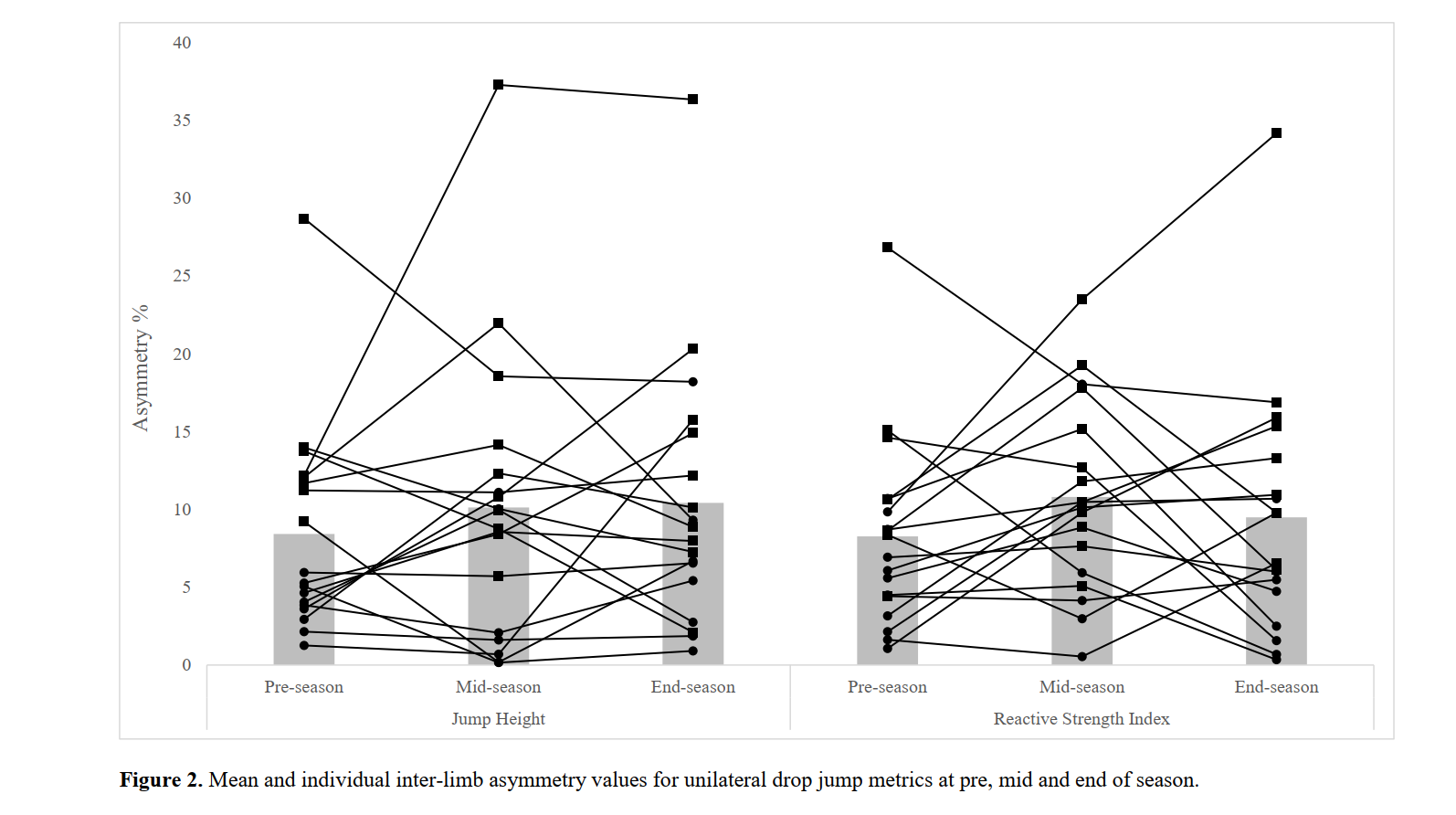
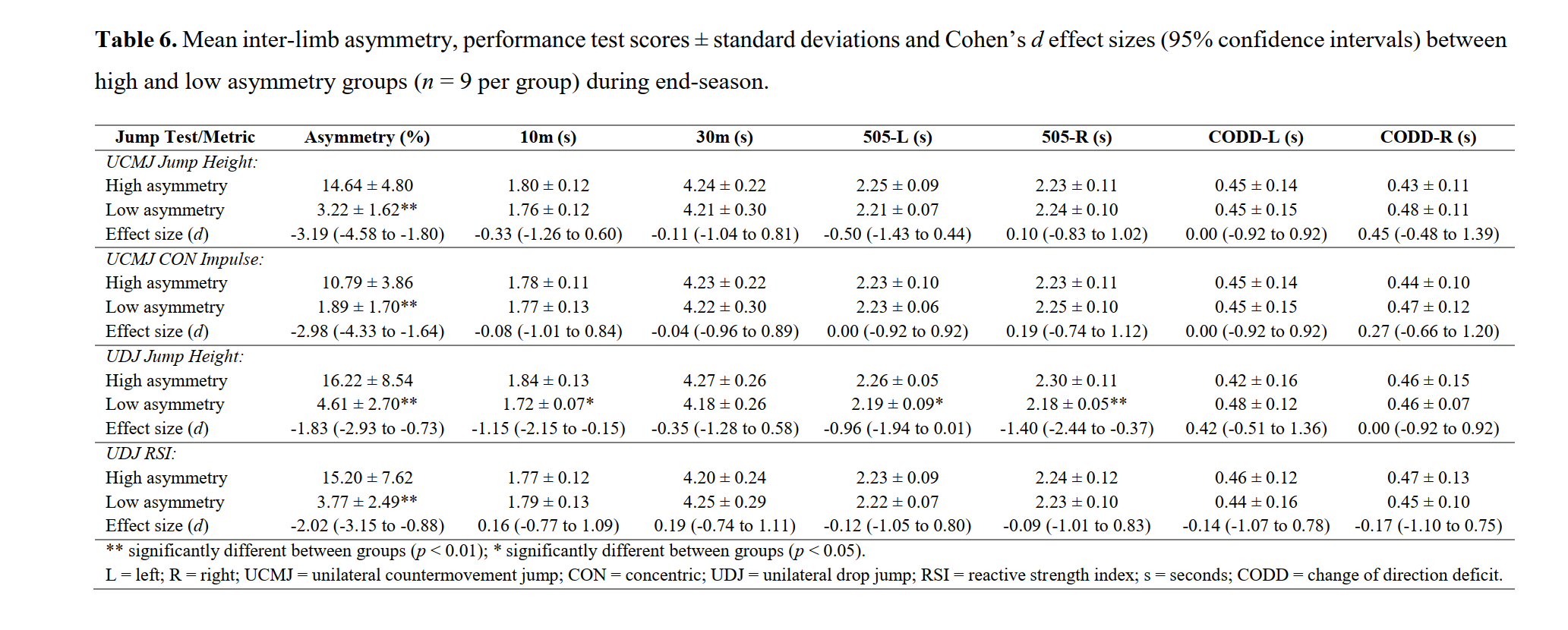
Bishop et al. (2022) – a longitudinal study across the entire season · Study DOI
Research so far does not provide a clear answer to whether inter-limb asymmetry affects football performance. In some studies, greater asymmetry was associated with poorer jumping, slower sprinting and worse change-of-direction ability, while others found no such relationship. Asymmetry should therefore not be seen as either completely unimportant or a direct cause of poorer performance. Its relevance depends on the test used, the variable analysed, the characteristics of the player and the timing of the assessment.
Is There a Universal Threshold of 10–15%?
Values of 10% and 15% are often used as thresholds above which an athlete is classified as asymmetrical. However, their use is not consistently supported by scientific evidence. In their systematic review, Parkinson et al. (2021) identified 18 studies that used a threshold to define abnormal asymmetry. Fifteen studies used a threshold between 10% and 15%, but this choice was often not supported by appropriate evidence.
Another problem is that the same percentage does not mean the same thing across different tests and variables. In a study of 203 professional football players, Read et al. (2021) reported considerable variation in asymmetry across different tests and physical abilities, with values ranging from 5.2% to 14.5%. The authors did not find a single threshold that could be applied to all assessments. Instead, they concluded that the values were specific to the task, variable and population. In the literature, values above 15% have been associated with a higher incidence of certain injuries, but asymmetries of at least 15% have also been recorded during landing tasks in uninjured young football players. A value of 15% on its own therefore does not confirm that there is a problem.
Hart et al. (2019) provide a good example of why a universal threshold is not appropriate. In uninjured players, a 10% asymmetry in concentric impulse would be more than two standard deviations above the group mean. In contrast, approximately the same value of 10% was close to the average asymmetry in eccentric rate of force development (RFD) during the deceleration phase. This variable showed the greatest asymmetry in previously injured and uninjured players, at 20.52% and 10.52%, respectively, with a large and statistically significant difference between the groups (d = 1.05). At the same time, no significant difference was found in eccentric deceleration impulse asymmetry.
Thresholds of 10% or 15% can therefore only serve as general reference values. A result should be interpreted in relation to the specific test and variable, measurement reliability, the results of both limbs and the same player’s previous values. One percentage alone cannot tell us whether an asymmetry is acceptable or requires intervention.
How Can Coaches Interpret and Use Inter-Limb Asymmetry in Practice?
First, a coach needs to establish whether the change in asymmetry is greater than the normal variability of the test. For example, a reduction from 12% to 10% may not represent a real improvement if the measurement error is 3%. Testing should therefore be carried out under similar conditions, using the same equipment, warm-up, protocol, number of attempts and method of processing the data. Without a reliable test, it is difficult to distinguish a real change from normal variation in results (Bishop et al., 2018; Bishop et al., 2019).
Alongside the final asymmetry percentage, we need to analyse the results of each limb separately. Asymmetry can increase because one leg performs worse, but also because the other leg improves more. Although the final percentage may be the same in both cases, the practical meaning is different. This is why the asymmetry percentage should be considered alongside the absolute values for force, impulse, jump height, contact time or whichever variable is being analysed.
Longitudinal monitoring has the greatest practical value, meaning that we compare a player with their own previous results. A sudden increase in asymmetry, a change in its direction or a simultaneous decline in one limb’s performance may be a reason for further assessment, particularly in a player returning from injury. However, some differences between the legs may develop as a functional adaptation to the demands of football. One leg is used more often for shooting and passing, while the other more often acts as the supporting leg, so complete symmetry may not always be a realistic or desirable goal (Bishop et al., 2018).
If the assessment shows that the asymmetry is real, consistent and accompanied by poorer performance in one limb, training can include unilateral and bilateral strength exercises, plyometric tasks and additional work for the weaker leg. However, the aim should not only be to reduce the asymmetry percentage, but to improve the capacity of the weaker limb and the player’s overall performance. Research so far shows that asymmetry can decrease without a simultaneous improvement in sprint or change-of-direction performance, which further confirms that a lower percentage does not always mean a better sporting result (Bishop et al., 2018).
Conclusion
Another challenge is that inter-limb asymmetry is a relationship between the results of two limbs, so it can show considerable variability. The same percentage can result from different changes in the performance of the left and right leg, while the group average can hide important individual differences. This means that the absence of a statistically significant change across the whole team does not necessarily mean that individual players have not experienced a relevant change in asymmetry. A coach should therefore look at each player individually and monitor the absolute results of both limbs alongside the asymmetry percentage (Bishop et al., 2021).
One isolated result is usually not enough to justify an intervention. A situation may need more attention when the same limb performs worse across several consecutive assessments, especially if the difference is greater than the normal variability of the test and is accompanied by a reduction in force, impulse or jump height. In contrast, frequent changes in the direction of asymmetry, without a decline in absolute results, may reflect normal performance variability. In practice, it is therefore more useful to follow a pattern over several weeks than to make a decision based on one percentage from a single assessment. Depending on the test and the variable we are monitoring, we also need to decide whether an intervention is necessary.
“When we consider how asymmetry impacts athletic performance, I have come to believe that it is probably not all that important.” Bishop, C. (n.d.). Inter-limb asymmetries: What impact do they actually have on performance? Sportsmith.
Practical Advice
Inter-limb asymmetry does not always have to be a bad thing or a reason to panic. What matters most is the context in which we are looking at it. After an injury, it can be an important parameter, and in the late stages of ACL rehabilitation it can give us useful indications before a return to the pitch. Depending on the test, we sometimes need to check whether the result is simply a measurement error or whether there is a real difference. For example, when looking at peak landing force, we need to take several measurements and potentially record a video to see whether the player really is using one leg more during landing. Depending on whether we are assessing neuromuscular fatigue, performance or rehabilitation, we use different tests and variables. We will cover this in more detail in the next blog posts. When it comes to performance, if there is no major deviation, asymmetry is probably not such an important parameter and may not be related to performance.
References
Bishop, C., Coratella, G., & Beato, M. (2021). Intra- and inter-limb strength asymmetry in soccer: A comparison of professional and under-18 players. Sports, 9(9), 129. https://doi.org/10.3390/sports9090129
Bishop, C., Read, P., Bromley, T., Brazier, J., Jarvis, P., Chavda, S., & Turner, A. (2022). The association between interlimb asymmetry and athletic performance tasks: A season-long study in elite academy soccer players. Journal of Strength and Conditioning Research, 36(3), 787–795. https://doi.org/10.1519/JSC.0000000000003526
Bishop, C., Turner, A., & Read, P. (2018). Effects of inter-limb asymmetries on physical and sports performance: A systematic review. Journal of Sports Sciences, 36(10), 1135–1144. https://doi.org/10.1080/02640414.2017.1361894
Fox, K. T., Pearson, L. T., & Hicks, K. M. (2023). The effect of lower inter-limb asymmetries on athletic performance: A systematic review and meta-analysis. PLOS ONE, 18(6), e0286942. https://doi.org/10.1371/journal.pone.0286942
Hart, L. M., Cohen, D. D., Patterson, S. D., Springham, M., Reynolds, J., & Read, P. (2019). Previous injury is associated with heightened countermovement jump force-time asymmetries in professional soccer players. Translational Sports Medicine, 2(5), 256–262. https://doi.org/10.1002/tsm2.92
Parkinson, A. O., Apps, C. L., Morris, J. G., Barnett, C. T., & Lewis, M. G. C. (2021). The calculation, thresholds and reporting of inter-limb strength asymmetry: A systematic review. Journal of Sports Science and Medicine, 20(4), 594–617. https://doi.org/10.52082/jssm.2021.594
Read, P. J., McAuliffe, S., Bishop, C., Oliver, J. L., Graham-Smith, P., & Farooq, M. A. (2021). Asymmetry thresholds for common screening tests and their effects on jump performance in professional soccer players. Journal of Athletic Training, 56(1), 46–53. https://doi.org/10.4085/1062-6050-0013.20
https://www.sportsmith.co/articles/limb-asymmetries-what-impact-do-they-have-on-performance/
CONTINUE LEARNING
Upcoming education and events
Loading dates…